
Do good deeds
Returning to right action through daily life


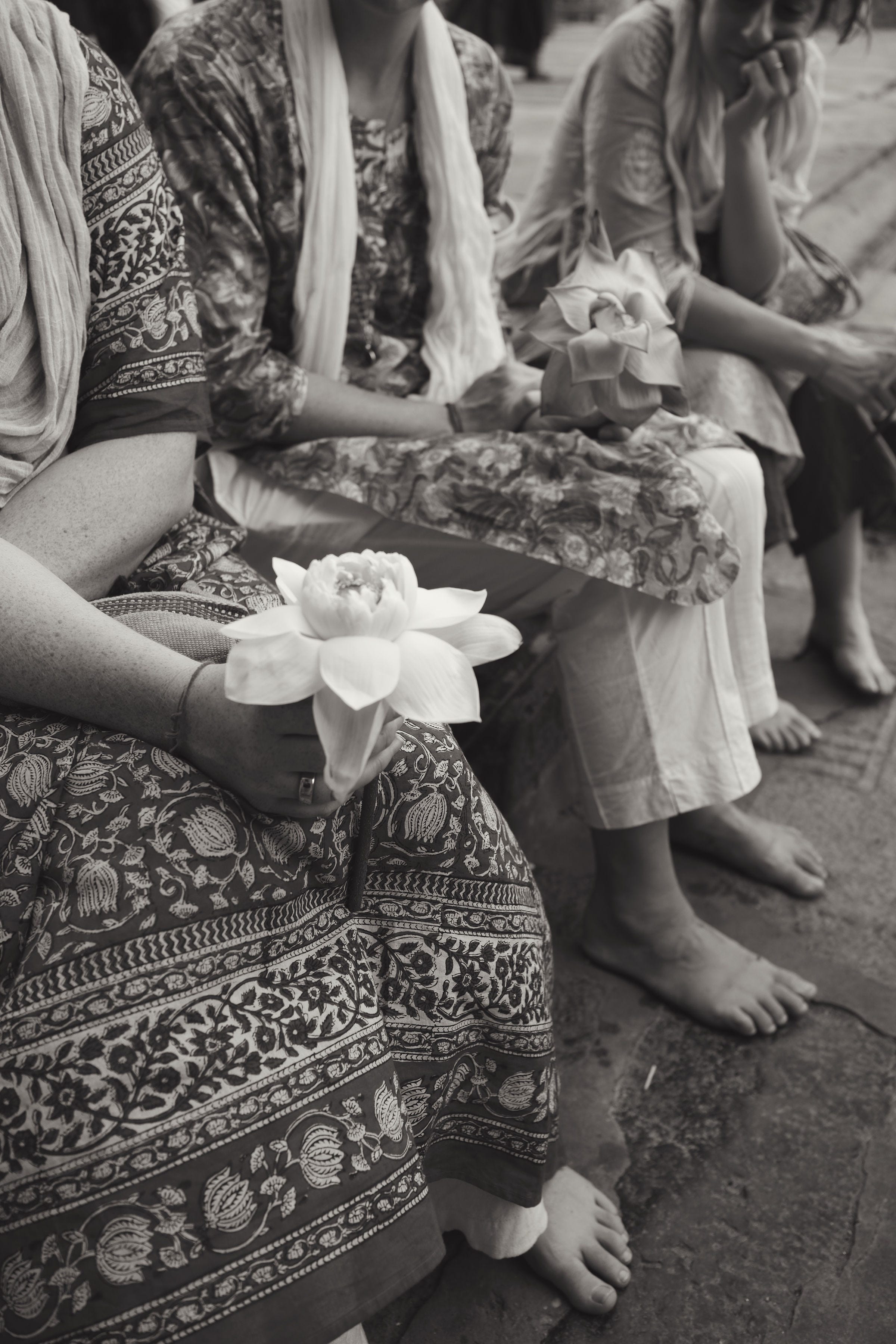
When I was in India recently staying at Sri Narayani Peedam, I kept hearing the same words repeated like a mantra - do good deeds. To be honest, I was a little dismissive when I first heard this phrase. It seemed a bit simple, a bit too shallow. That was my own bias coming out - that depth came from clever statements and big words. But the more I heard it, the more it landed. In that phrase lives the entire architecture of the Vedic worldview.
It’s easy to think that spirituality must be complex - a weaving of doctrines, lineages, and stages of enlightenment. But when it comes to the living experience of this wisdom in daily life, things clarify. The Vedas are not asking us to perform holiness; they are asking us to participate rightly in the flow of life. For example, Sri Sakthi Amma, the guru at Sri Narayani Peedam says, “Try to help at least one person each day.” It doesn’t have to be grand - a kind word, a softening gesture, a quiet offering of support. Over and over, she returns us to this simplicity: do good deeds.
Good deeds are not moral performances - they are right resonance. They are what happens when consciousness acts in tune with itself.
The resonance of karma.
In a recording during a his earlier years of teaching, Maharishi Mahesh Yogi said,
“…karma means action. We don’t get freedom from action; we get freedom from the binding influence of the action.”
He described karma not as a moral scoreboard but as vibration - an energetic ripple that moves through creation and inevitably returns to its source. Every thought, every word, every gesture sends its vibration into the field of life. “Just as a calf will find its mother among a thousand cows,” he said, “so the karma will find its doer.”
It’s a poetic way of saying that nothing is lost. Our actions move through the atmosphere, through people, through time, through galaxies, and eventually return to us in some form. But Maharishi was clear: the aim is not to stop acting, but to act freely.
“Freedom from karma does not mean freedom from doing karma,” he said. “We can’t be without doing action. As long as the body, the mind, the senses are alive, action continues.”
Freedom comes when we act without attachment, without the mind taking on the impression. It’s when action arises from stillness rather than reaction. This is the refinement of karma: to live in the world fully, act completely, and yet remain inwardly unbound.
Sri Sakthi Amma’s teaching of ‘do good deeds’ is another doorway into this same truth. It offers a practical way of ensuring our actions remain harmonious, evolutionary, and aligned. Maharishi explained that good means that which supports evolution, and bad means that which pulls us away from it. Doing good deeds is not about morality; it is about keeping the current of life flowing toward expansion.
When we act in ways that uplift others, we strengthen that current. When we harm or criticise, we send vibrations that inevitably return, creating inner disturbance. Maharishi warned of this very thing: “nothing is more damaging than talking ill of someone or reflecting on the sin done by someone. Save yourself from your mind going to bad things.”
Every thought, every word, and deed is karma. And so, the simple act of doing good becomes a means of cleaning our inner atmosphere.
On destiny.
Maharishi often said that meditation releases the binding influence of karma - the part that creates impression and attachment - but it doesn’t remove the need for right action.
“The technique itself is not going to help us. We have to use the technique... We must depend upon our using the technique. Fulfilment is not going to come to us of itself... One must also think rightly and act rightly.” - Maharishi Mahesh Yogi
It’s not enough to sit in stillness; we must live the stillness in motion. We can’t meditate our way out of responsibility. Life asks us to work out our destiny through the daily choice to act from clarity and presence.
If you like simplicity, this is what Sri Sakthi Amma’s statement offers us: a framework to hold all the complexity. ‘Do good deeds’ becomes a compass for right thinking and right action. It helps us discern where to place our attention and energy.
When we are unsure of our purpose, unsure of what the next step is, we can return to this: help someone, serve someone, speak kindly, act truthfully, move with care. These are not small things; in fact, they are the fabric of dharma made visible.
In the Vedic view, dharma (that which upholds) and karma (action) are not separate. Dharma is the natural expression of our highest awareness in motion. Sometimes it’s referred to as ‘purpose’. But it’s not something to find; it’s something that unfolds when we live rightly, moment by moment.
When we meditate, we touch the unbounded field of Being. When we act from that place, our actions carry a fragrance of that stillness. Maharishi called this “acting without impression,” and it is the essence of freedom.
Sri Sakthi Amma expresses it in another way - through simple, direct goodness. Because when we do good deeds, the mind remains light. We are not adding unnecessary weight to our field of experience. We are participating consciously in the flow of evolution.
And perhaps that’s the real secret: karma is not a system to fear but a guiding force to keep us on track. It’s the great conversation between our inner and outer worlds. When we meditate, act rightly, and serve sincerely, life begins to harmonise itself around us. Fulfilment, as Maharishi said, doesn’t arrive as a reward; it emerges as a natural consequence of living in tune with life.
That’s it - the whole of karma distilled into daily life.
And in this simplicity, we find not only purpose, we find peace.
With love,
Sarah x
Resources to explore.
Read more about Sri Sakthi Amma’s words on doing good deeds by visiting the Sri Narayani Peedam website.
Learn directly from Maharishi by reading his commentary on the first 6 chapters of the Bhagavad Gita where he distills this for knowledge for living and so much more.
Group meditation timetable.
Join us this week for a group meditation and wisdom session. Open to all Vedic meditators. Please book in via the timetable.
Tuesday 18 November- 6:30pm-7:30pm AEDT (5:30pm-6:30pm AEST) online with Sarah O’Brien.
Wednesday 19 November - 6:30pm-8pm in Cheltenham with Sarah O’Brien.
Wednesday 20 November - Every Wednesday 6am FREE meditation, swim and chai at Noosa Main beach. Open to anyone to attend. Tell your friends! Follow us @noosa_meditation to stay in touch.
Upcoming courses + offerings.
Gift yourself a lifelong practice for health, happiness, and deeper connection. Join our community and be supported for life. We currently teach in-person courses in:
MELBOURNE - NOOSA - CASTLEMAINE
20-23 November - Vedic meditation course in Melbourne with Sarah
4-7 December - Vedic meditation course in Melbourne with Sarah
1-4 January - Vedic meditation course in Noosa with Laura
3-6 January - Vedic meditation course in Melbourne with Sarah
15-18 January - Vedic meditation course in Noosa with Laura
Mahasoma Retreats 2026
South India Retreat 2-16 February, 2026
Join us for a two-week South India retreat from 2–16 February 2026.
If you’re seeking to deepen your relationship with Vedic meditation, explore the Vedic culture, expand your heart to flow in devotion, have mind blowing conversations on the nature of reality and purpose of life, and walk alongside like-hearted meditators on the path, then this retreat is for you! This intimate pilgrimage is both an outer and inner journey. A return to the Self, to love, and to the boundless silence that lives within all things.
Email laura@mahasoma.com to receive the retreat PDF details. Limited spaces.


Free discovery call.
We get it! Booking in to a 4-session in-person course is a commitment. Looking to learn Vedic meditation but want to meet your teacher and know more before signing up? Book in for a free Q&A discovery call.
Who is Mahasoma?
The Mahasoma team is a feminine-led collective of Vedic meditation teachers, who choose to come together to create something greater than what could be done as individuals. Through working together they support the ever growing community of Mahasoma meditators by offering Vedic meditation courses, online and in-person group meditation and Vedic wisdom sessions, advanced trainings, and retreats. They are accredited Mental Health First Aiders and have been trained in pre- and/or postnatal support for women and families.
Want to know a little more on who and what we are? We’ve written a few things on our website you can check out. We would love to connect with you!
 | A guest post by
|
I love this post Sarah. The suggestion to ‘do good deeds’ resonates with me so much - as does choosing action that expands us and others. Thank you for sharing your thoughtful and inspiring words. 🙏🏼🥰💗🧚♀️🐝
🙏 thank you